

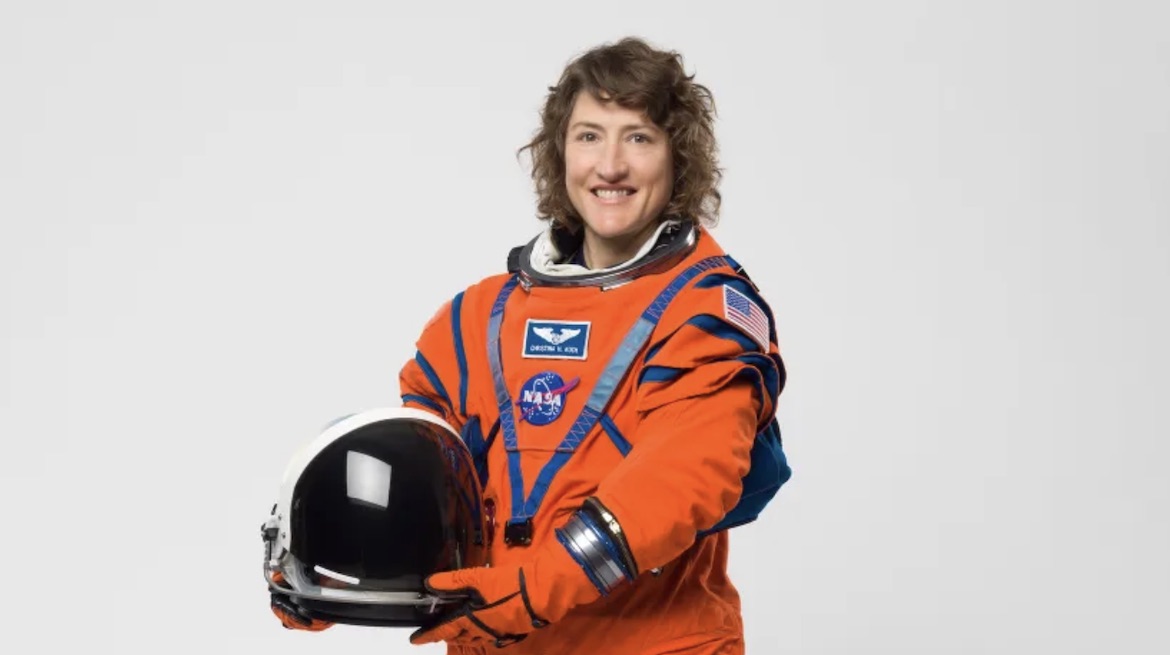
A mission specialist on the Artemis II flight, Koch is about to become the first woman to travel beyond low Earth orbit. Her story combines technical mastery, resilience and a commitment to expanding opportunities for women in science.
Born in Michigan and raised in North Carolina, Christina Koch earned bachelor’s degrees in electrical engineering and physics and a master’s degree in electrical engineering from North Carolina State University. Before joining NASA, she honed her skills in some of the world’s most challenging environments. She wintered at the Amundsen‑Scott South Pole Station as part of the United States Antarctic Program and worked as a field engineer in remote locations such as Alaska and American Samoa. These experiences prepared her for the isolation and rigors of spaceflight.
Koch was selected as an astronaut in 2013 and launched to the International Space Station (ISS) in March 2019. Over the next 328 days, she lived and worked aboard the ISS, setting a record for the longest continuous spaceflight by a woman. During this mission she conducted six spacewalks, three of which were historic all‑female excursions with fellow astronaut Jessica Meir. Beyond the headline‑making moments, her work included robotics for upgrades to the Alpha Magnetic Spectrometer, growing protein crystals for pharmaceutical research and experimenting with 3D biological printing in microgravity. Her accomplishments underscored the importance of long‑duration missions in preparing for deeper space exploration.
After returning to Earth in February 2020, Koch served in leadership roles within NASA’s Astronaut Office and continued to train for future missions. Her selection for Artemis II is both a recognition of her expertise and a milestone for representation. The Artemis program is designed to return humans to the Moon and eventually pave the way for Mars exploration. While Apollo missions sent only men to the lunar surface, Artemis aims for diversity: Koch will be joined by Victor Glover, the first person of color on a lunar mission, commander Reid Wiseman and Canadian astronaut Jeremy Hansen.
Artemis II, currently targeted for launch in March 2026, is a ten‑day test flight that will orbit Earth, slingshot around the Moon and travel approximately 10,300 km beyond its far side. The crew will test life‑support systems, navigation and communication in deep space. For Koch, the mission is a continuation of her lifelong pursuit of exploration. Her engineering background and experience in extreme environments make her an ideal candidate to evaluate the Orion spacecraft’s performance and conduct observations of potential landing sites for future missions. The data she and her colleagues collect will inform Artemis III, which plans to land astronauts on the lunar south pole later this decade.
Koch’s journey resonates beyond space science. She has often spoken about the importance of representation, noting that seeing people who look like you in different roles can expand a child’s sense of what is possible. By breaking endurance records and now flying farther than any woman before, she is creating new role models for aspiring scientists and explorers. Her hobbies—surfing, rock climbing, coding and community service—also reveal a well‑rounded life that balances technical rigor with creativity and compassion.
As the world watches Artemis II prepare for launch, Christina Koch embodies the spirit of human spaceflight: curiosity, perseverance and a dedication to pushing boundaries. Her mission will be more than a technological demonstration; it will be a cultural landmark showing that space is for everyone. When she loops around the Moon and gazes back at Earth, Koch will carry the legacy of women who built spacecraft and dreamed of the stars—and she will inspire the next generation to aim even higher.
© Photo: NASA